

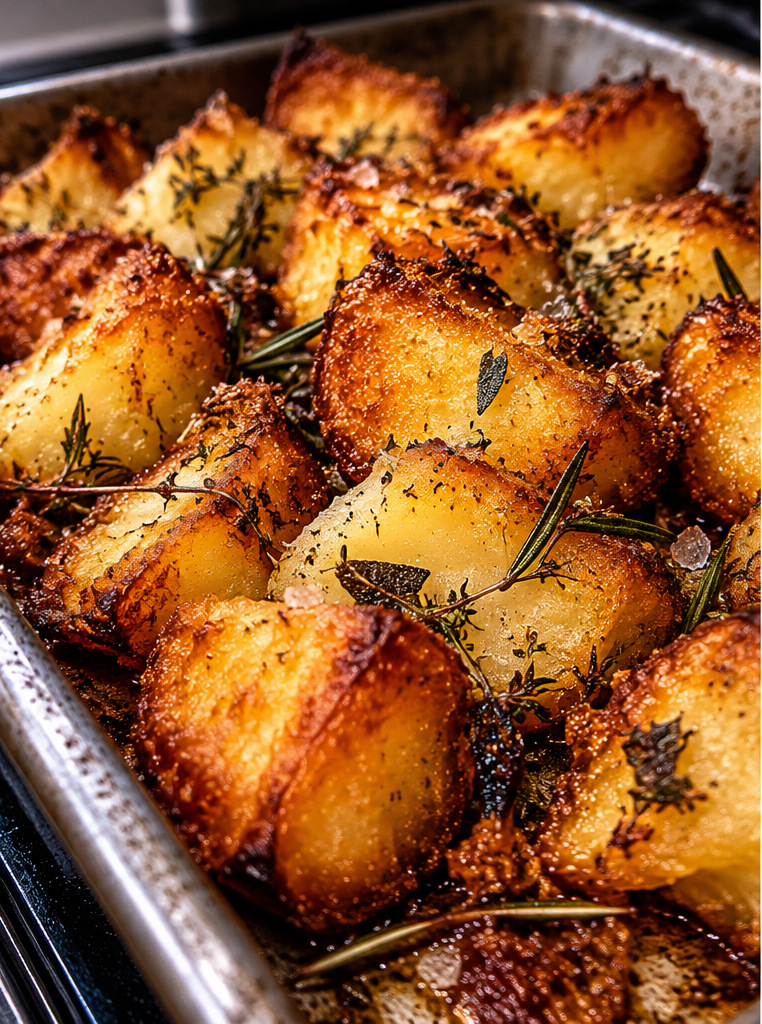
I want my roasties deep golden, properly crispy on the outside and fluffy in the middle, not pale, neat little potatoes. My favourite spud for the job is the King Edward. They were my grandad’s favourite and they’re mine too. I peel them to make lots of deep flat angles, deliberately take the boil further than most recipes suggest, then shake them with a ridiculous quantity of rosemary, thyme, sage and Maldon salt. They go straight into hot oil, get turned to coat, then I brush butter over the top before roasting at 240°C fan for at least 45 minutes. The ragged edges go beautifully crisp. That’s the whole point.
SERVES: about 6 · PREP: 20–30 minutes plus boiling · ROAST: at least 45 minutes at 240°C fan, longer if they need more colour. I normally judge doneness by the colour and crunch, not an exact minute on the clock.
Ingredients
- King Edward potatoes — my preferred roastie, and my grandad’s favourite too (about 1.5 kg for six as a practical quantity)
- 4 good pinches of Maldon sea salt, added to the drained potatoes before shaking
- 4 tbsp rosemary
- 4 tbsp thyme
- 2 tbsp sage
- Oil for the preheated roasting tray — enough to coat each potato properly when turned (rapeseed or another high-heat roasting oil)
- Butter to brush generously over the hot potatoes before they go into the oven
- A large saucepan with lid, colander, heavy metal roasting tray and a pastry brush
Method
- Peel for angles, not neatness. I peel the King Edwards to create plenty of deep, flat faces and sharp corners. I don’t want smooth, round potatoes. Keep the pieces a broadly similar size so they cook together, but make the edges deliberately angular — those are what turn into the crunchy bits.
- Get the oil hot. While the potatoes are boiling, preheat the oven to 240°C fan. Put the heavy metal roasting tray and oil into the oven to get properly hot. The fat should be ready to sizzle when the drained potatoes land in it; make sure the tray is stable and leave enough room between the pieces.
- Overboil — deliberately. Put the potatoes in a large pan of water and boil them until they’re very soft, almost at the point of falling apart, but still holding their shape. That’s further than the usual parboil. Test the biggest piece with a knife: it should slide through easily, but the potato shouldn’t disintegrate when lifted. The exact time depends on how big you cut them.
- Drain thoroughly. Tip the potatoes carefully into a colander and give the steam a little time to escape. I want them tender and dry enough on the outside that they rough up properly, not dripping water into hot oil.
- Season before the shake. Return the drained potatoes to the empty saucepan. Add four good pinches of Maldon salt, four tablespoons of rosemary, four tablespoons of thyme and two tablespoons of sage. Yes, that’s a lot of herbs. These are proper herby roasties, not potatoes that have merely been waved near a sprig of rosemary.
- SHAKE. Put the lid on firmly, hold it in place and give the saucepan a good, deliberate shake. I want the outer surfaces to break down into a rough, fluffy coating, with all the salt and herbs caught in the edges. Stop before the potatoes become mash. It’s that starchy, shaggy surface that gives me the crust I want.
- Into hot oil. Wearing oven gloves, carefully take out the hot tray. Lower the potatoes into the oil away from you so it doesn’t splash. They should sizzle. Use a metal spoon or tongs to rotate each potato until all its sides are coated. Spread them in one layer with space between them.
- Brush with butter. While the potatoes are hot, brush butter across the tops. It melts onto the surfaces and through those rough edges. Don’t drown the tray — I want the oil and butter coating the spuds rather than a puddle of liquid at the bottom.
- Roast hard and hot. Put the tray back into the oven at 240°C fan for at least 45 minutes. Check partway through, and turn carefully if one side is colouring faster. Butter and herbs can catch at this temperature, so keep an eye on any dark patches without pulling them while the potatoes are still pale.
- Judge by the crust. I’m after a proper deep golden colour, sharply crisp edges and a soft fluffy middle. If they’re merely light gold at 45 minutes, give them longer, checking regularly. They should crunch when you cut into one. Serve straight away, ideally with the main roast and plenty of gravy.